

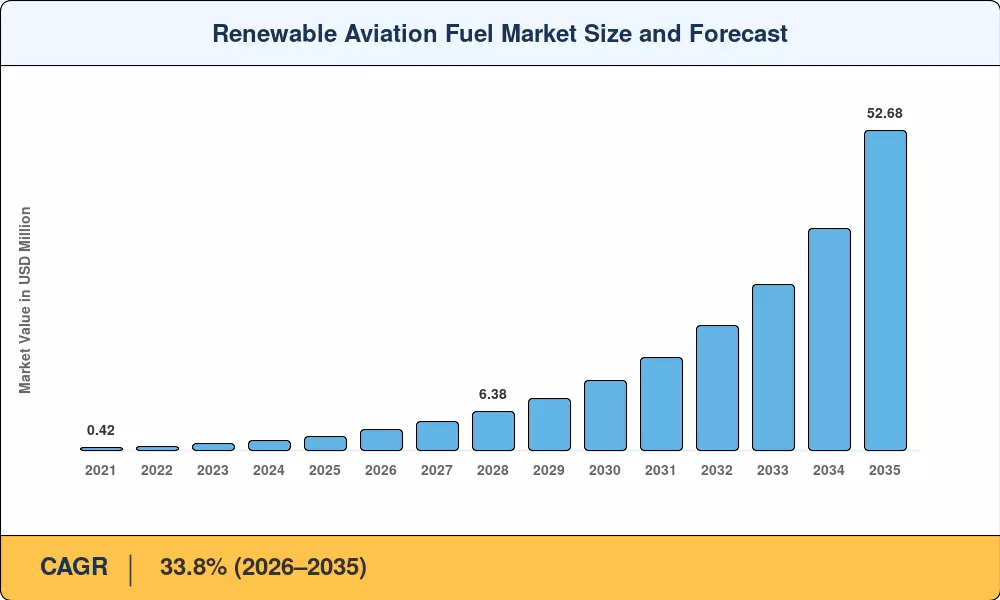
Renewable Aviation Fuel Market Set for Explosive Growth To USD 52.68 billion by 2035 at a CAGR of 33.8%
Renewable Aviation Fuel Market Summary
The European Union's ReFuelEU Aviation regulation now mandates a 2% sustainable aviation fuel blending obligation from 2025 rising to 6% by 2030
NY, CA, UNITED STATES, June 22, 2026 /EINPresswire.com/ -- The Renewable Aviation Fuel Market reached an estimated USD 2.38 billion in 2025, with the forecast period opening at USD 3.42 billion in 2026 and climbing to USD 52.68 billion by 2035 at a CAGR of 33.8%.Renewable Aviation Fuel Market Overview
The Renewable Aviation Fuel Market trends encompasses the production, distribution, and consumption of sustainable aviation fuel (SAF)—a drop-in alternative to conventional jet fuel derived from non-petroleum feedstocks. SAF is produced from renewable sources such as used cooking oil, agricultural residues, municipal solid waste, and captured carbon dioxide combined with green hydrogen, using technologies like Hydroprocessed Esters and Fatty Acids (HEFA), Alcohol-to-Jet (ATJ), and Power-to-Liquid (PtL) processes. This fuel can reduce lifecycle greenhouse gas emissions by up to 80% compared to fossil jet fuel.
The market is experiencing a fundamental shift from voluntary sustainability pledges to binding compliance frameworks. The European Union's ReFuelEU Aviation regulation mandates a 2% SAF blending obligation from 2025, rising to 6% by 2030 and 70% by 2050. Similarly, the U.S. Inflation Reduction Act's Section 45Z production tax credits have unlocked over USD 5 billion in announced SAF plant investments.
Key industry trends include the rapid scaling of power-to-liquid e-fuel aviation platforms and the commercialization of alcohol-to-jet pathways. Solid-oxide electrolysis paired with modular Fischer-Tropsch reactors has reduced the SAF cost premium vs. jet fuel from 4× to approximately 2.5× at demonstration-scale facilities. However, SAF production remains limited—IATA projects global production will reach only 2.4 million tonnes in 2026, representing just 0.8% of aviation fuel use.
Policy and regulatory influence is the primary market catalyst. The International Civil Aviation Organization's CORSIA scheme, ReFuelEU Aviation, the U.S. SAF Grand Challenge (3 billion gallons by 2030), and national targets in Japan (10% by 2030), India (1% by 2027), and Singapore are creating legally enforced demand floors. Corporate net-zero pledges and Scope 3 reporting requirements further drive off take agreements.
Demand outlook is strongly positive, with the market projected to exceed USD 50 billion by 2035. North America currently commands a 45.2% share, while Europe exhibits the fastest growth trajectory, followed by Asia-Pacific emerging as a dynamic production and consumption hub.
Get Free Sample Report for Detailed Market Insights:
https://www.marketresearchfuture.com/sample_request/41586
Renewable Aviation Fuel Market Segmentation
The Renewable Aviation Fuel Market is segmented by feedstock, technology, blending level, and application.
By Feedstock:
Used Cooking Oil and Waste Fats: Captured 43.1% of the market in 2025, reflecting mature HEFA supply chains and favorable economics.
Industrial CO₂ and Green H₂: Projected to register a 54.6% CAGR through 2035, driven by falling electrolyzer costs and e-SAF mandates.
Municipal Solid Waste: Growing segment leveraging waste diversion incentives.
Agricultural Residues and Energy Crops: Fast-growing due to ATJ pathway maturation.
Others: Algae and forestry residues remain in R&D stages.
By Technology:
Hydroprocessed Esters and Fatty Acids (HEFA): Dominates with 74.2% share, benefiting from ASTM D7566 certification advantage.
Alcohol-to-Jet (ATJ): Commercially scaling with ethanol feedstock abundance.
Power-to-Liquid / E-SAF: Fastest-expanding conversion pathway, anticipated to grow at 51.3% CAGR through 2035.
Gasification + Fischer-Tropsch: Growing as municipal solid waste and biomass valorization expands.
By Blending Level:
10–50% Blend: Dominant segment, capturing 82.4% of the market, aligned with regulatory mandates and off take agreements.
50–100% Blend: Fastest-growing, driven by 100% SAF flight demonstrations and engine OEM approvals.
Up to 10% Blend: Entry-level compliance segment.
By Application:
Commercial Airlines: Largest segment at 85.1%, driven by regulatory mandates and Scope 3 reporting.
Cargo and Freight: Growing at 29.3% CAGR, fueled by e-commerce logistics and shipper sustainability requirements.
Business and General Aviation: Emerging segment driven by corporate travel policies.
Military and Government: Expanding with defense energy security priorities.
You can buy this market report at:
https://www.marketresearchfuture.com/checkout?currency=one_user-USD&report_id=41586
Technology Advancements
HEFA Technology Maturity and Limitations: HEFA remains the dominant production pathway due to its compatibility with existing refinery infrastructure. However, feedstock availability—used cooking oil supply is capped at roughly 15 million tonnes globally—is forcing producers to diversify. Producers are increasingly converting brownfield assets to HEFA production while exploring alternative feedstocks.
Power-to-Liquid (PtL) and E-SAF Scaling: PtL technology, which combines captured CO₂ with green hydrogen via Fischer-Tropsch synthesis, represents the most transformative growth vector. Germany's dedicated 0.5% PtL sub-mandate within ReFuelEU has catalyzed a pipeline of announced European PtL projects totaling 1.8 million tonnes of annual capacity by 2032. However, e-SAF production currently faces significant challenges—global capacity under construction stands at only 0.02 million tonnes with one single production site in operation, and no new final investment decisions for e-SAF facilities have been made over the past year.
Alcohol-to-Jet (ATJ) Commercialization: ATJ pathways are gaining traction, converting ethanol from sugarcane, corn, or cellulosic feedstocks into jet fuel. LanzaJet's Freedom Pines facility in Georgia achieved commercial milestone as the world's first industrial-scale ATJ facility. Brazil's abundant sugarcane ethanol surplus and India's agricultural-residue base position these countries as potential ATJ production hubs.
Book-and-Claim Systems and SAF Certificates: Digital platforms enabling transparent tracking of SAF environmental attributes have become vital for market scaling. Book-and-claim mechanisms decouple the physical fuel from its emissions reduction value, allowing corporate customers to purchase SAF certificates even when fuel is not available at their airports. These systems are critical for creating a global SAF market with harmonized standards and avoiding double-counting.
Digital Analytics and Lifecycle Tracking: Airlines and fuel suppliers are investing in platforms that track SAF lifecycle emissions, feedstock provenance, and regulatory compliance in real time. These analytics tools enable dynamic SAF blending optimization and generate monetizable sustainability data for corporate ESG reporting.
Renewable Aviation Fuel Market Regional Insights
North America: Dominates with 45.2% share, anchored by U.S. refinery conversions, Section 45Z tax credits (up to USD 1.75 per gallon), and the SAF Grand Challenge targeting 3 billion gallons by 2030. California and Washington's low-carbon fuel standard programs, combined with off take agreements from Delta, United, and American Airlines, drive demand. Montana Renewables' 300-million-gallon HEFA facility in Great Falls became the world's largest dedicated SAF plant in 2024, while Phillips 66's Rodeo Renewed refinery in California began commercial-scale co-processing.
Europe: The fastest-growing region with a projected 39.5% CAGR through 2035, propelled by ReFuelEU Aviation mandates. Germany leads with dedicated PtL sub-mandates, while the UK's Revenue Certainty Mechanism supports SAF investment. Airports in Amsterdam, Paris, and Frankfurt have invested a combined EUR 650 million in dedicated SAF storage and hydrant blending infrastructure. The EU Methane Regulation and carbon pricing mechanisms further incentivize adoption.
Asia-Pacific: Representing approximately 18.4% share, this region exhibits the most dynamic growth frontier. China's CAAC SAF pilot program, India's national biofuel policy, and Japan's ACT-for-SAF consortium (JPY 300 billion commitment) are driving investment. India's plan to integrate SAF into existing ethanol blending infrastructure leverages over 1,200 sugar mills as potential ATJ feedstock suppliers. Singapore Changi Airport is emerging as a regional blending hub.
South America: Brazil leads with abundant sugarcane ethanol surplus (exceeding 35 billion litres annually), positioning the country as a natural ATJ production hub. LATAM Airlines signed a 500,000-tonne off take agreement with local producers in 2024, while Argentina's state-owned YPF announced USD 400 million investment in SAF production from agricultural residues and waste oils.
Middle East & Africa: Saudi Arabia's NEOM project envisions large-scale green hydrogen production for PtL synthesis, while the UAE's Masdar partnered with Etihad Airways to develop a 50,000-tonne SAF plant near Abu Dhabi using solar-powered electrolysis.
To explore more market insights, visit us at:
https://www.marketresearchfuture.com/reports/renewable-aviation-fuel-market-41586
The Renewable Aviation Fuel Market is poised for exponential growth, projected to expand from USD 3.42 billion in 2026 to USD 52.68 billion by 2035. This trajectory is anchored by binding regulatory frameworks—notably ReFuelEU Aviation and the U.S. SAF Grand Challenge—and supported by corporate net-zero commitments and passenger willingness to pay for sustainable travel. HEFA technology currently dominates production, but power-to-liquid and alcohol-to-jet pathways represent the fastest-growing segments as feedstock diversification and green hydrogen economics improve.
North America leads in production capacity, while Europe drives regulatory innovation and Asia-Pacific emerges as a dynamic growth frontier. However, challenges persist: SAF production in 2026 is expected to meet only 0.8% of global aviation fuel demand at a cost of USD 4.3 billion to airlines. Scaling requires coordinated action across renewable energy supply, infrastructure access, policy certainty, and book-and-claim mechanisms. As the aviation sector commits to net-zero targets, SAF remains the most viable and scalable pathway for decarbonizing air travel.
More Related Reports from MRFR Library:
Iot In Energy Market https://www.marketresearchfuture.com/reports/iot-in-energy-market-25638
Lithium Ion Battery Energy Storage System Market https://www.marketresearchfuture.com/reports/lithium-ion-battery-energy-storage-system-market-25654
Land Drilling Rig Market https://www.marketresearchfuture.com/reports/land-drilling-rig-market-25891
Primary Lithium Battery Market https://www.marketresearchfuture.com/reports/primary-lithium-battery-market-26011
Platform Supply Vessels Market https://www.marketresearchfuture.com/reports/platform-supply-vessels-psv-market-26120
Pole Mounted Transformer Market https://www.marketresearchfuture.com/reports/pole-mounted-transformer-market-26125
Electronically Commutated Motor Market https://www.marketresearchfuture.com/reports/electronically-commutated-motor-market-26315
Oil Immersed Shunt Reactor Market https://www.marketresearchfuture.com/reports/oil-immersed-shunt-reactor-market-28717
Utility Electrical Conduit Market https://www.marketresearchfuture.com/reports/utility-electrical-conduit-market-29315
Well Stimulation Material Market https://www.marketresearchfuture.com/reports/well-stimulation-material-market-30869
Larry Wilson
WantStats Research And Media Pvt. Ltd.
+1 855-661-4441
email us here
Visit us on social media:
LinkedIn
Facebook
YouTube
X
Legal Disclaimer:
EIN Presswire provides this news content "as is" without warranty of any kind. We do not accept any responsibility or liability for the accuracy, content, images, videos, licenses, completeness, legality, or reliability of the information contained in this article. If you have any complaints or copyright issues related to this article, kindly contact the author above.
