

Smart Personal Protective Equipment Market to Reach USD 6.96 Billion by 2035 at 12.5% CAGR
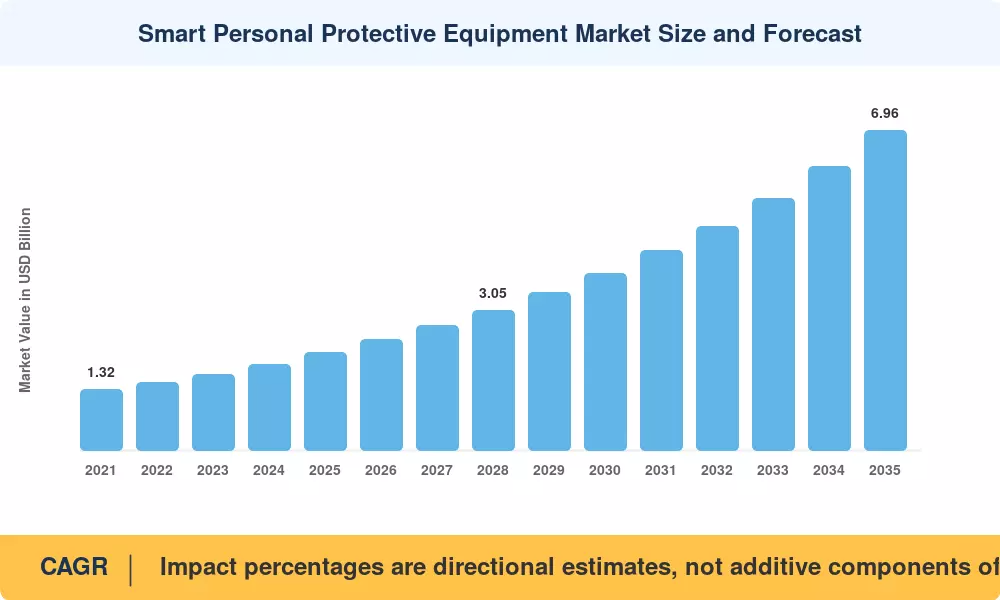
Smart Personal Protective Equipment Market
The Smart Personal Protective Equipment Market reached an estimated USD 2.14 billion in 2025 and is projected to grow from USD 2.41 billion in 2026
The Smart Personal Protective Equipment Market reached an estimated USD 2.14 billion in 2025 and is projected to grow from USD 2.41 billion in 2026 to USD 6.96 billion by 2035”
NEW YORK, NEW YORK, UNITED KINGDOM, July 28, 2026 /EINPresswire.com/ -- The Smart Personal Protective Equipment Market reached an estimated USD 2.14 billion in 2025 and is projected to grow from USD 2.41 billion in 2026 to USD 6.96 billion by 2035, registering a CAGR of 12.5% during the 2026–2035 forecast period.— Arti Dhapte
Market Overview
Smart Personal Protective Equipment (PPE) represents a transformative evolution in occupational safety, integrating sensors, connectivity, and real-time monitoring capabilities into traditional protective gear . These next-generation wearables provide continuous feedback on worker health, environmental conditions, and task safety compliance, fundamentally shifting the safety paradigm from reactive incident response to proactive hazard mitigation . Smart PPE encompasses a diverse range of products including connected helmets, intelligent safety vests, exoskeletons, gas detection wearables, and augmented reality-enabled eyewear, each designed to enhance worker protection while enabling data-driven safety management .
The market's robust growth is driven by several converging factors. Increasing workplace safety regulations and tightening government standards, including those enforced by OSHA, NIOSH, and EU-OSHA, are compelling organizations to adopt advanced safety solutions . The rising incidence of workplace accidents—with private industry injuries in the US increasing to 2,368.9 in 2023 from 2,343.6 in 2022—has heightened awareness of occupational health risks and accelerated demand for intelligent protective equipment . Additionally, the cost of downtime from preventable injuries and insurance premium incentives for organizations demonstrating improved safety performance are further motivating investment in technology-driven safety programs .
Industry trends indicate a significant shift from traditional passive PPE to connected, intelligent safety infrastructure. This transformation is being driven by the growing digitalization of industrial operations and the integration of Industry 4.0 and IIoT initiatives across manufacturing, construction, and resource extraction sectors . The convergence of safety requirements with broader digital transformation strategies is positioning smart PPE as an indispensable component of enterprise safety and operational intelligence .
Technological developments are occurring rapidly across multiple fronts. Advanced systems now incorporate AI engines that classify risk levels and support predictive modeling, alongside augmented reality visors for remote guidance and real-time task overlay . The development of energy-autonomous systems, such as 3M's PELTOR WS Alert XPV smart headset featuring Powerfoyle solar technology that harvests energy from both indoor and outdoor light, is addressing sustainability concerns and operational inefficiencies associated with battery replacement . Biometric sensors monitoring vital signs including heart rate, temperature, hydration, and fatigue levels are being increasingly integrated, while environmental sensors detect toxic gases, radiation, and noise exposure .
Policy and regulatory influence is profoundly shaping the market. The implementation of EU Regulation (EU) 2025/123 in December 2025 mandates the inclusion of connected technologies in designated high-risk protective equipment categories, fundamentally shifting smart features from optional enhancements to baseline requirements . This regulatory push is also standardizing interoperability protocols, ensuring that connected PPE devices can communicate seamlessly with site management platforms and emergency response systems . Governments worldwide are investing in research and development initiatives and establishing standards and certifications to ensure the quality and effectiveness of smart PPE solutions .
The demand outlook remains exceptionally strong. The market is evolving from pilot deployments to scaled implementations across multiple sectors . Rising demand for lightweight, comfortable, and multifunctional protective gear is further supporting market growth . The expansion of smart PPE into emerging markets, combined with the growing awareness of occupational health risks in developing economies, positions the market for sustained expansion throughout the forecast period .
📍 Get Free Sample Report for Detailed Market Insights:
https://www.marketresearchfuture.com/sample_request/24776
Market Segmentation
By Product Type
The smart PPE market is segmented by product type into Smart Helmets / Hard Hats, Gas Detection Wearables, Exoskeletons, Smart Safety Vests, Smart Gloves, Smart Eyewear, and Other Wearables. Smart helmets and hard hats represent a significant segment, integrating sensors for fatigue tracking, proximity detection, and impact monitoring . Gas detection wearables provide continuous monitoring for toxic gases, oxygen levels, and other airborne hazards critical in oil, gas, and mining operations. Exoskeletons, designed to reduce worker fatigue and prevent musculoskeletal injuries, are gaining traction in manufacturing and construction applications . Smart safety vests equipped with GPS, geofencing, and biometric sensors enable personnel accountability and evacuation management during emergencies . Smart gloves with integrated sensors detect dangers such as cuts, chemical exposure, and temperature variations, delivering real-time safety alerts . Smart eyewear, including AI-enabled glasses, provides hands-free access to real-time workflow information, notifications, and hazard detection capabilities . Other wearables include smart footwear, respiratory protection, and hearing protection devices with connectivity capabilities .
By End-Use Industry
End-use segmentation covers Construction, Oil & Gas, Manufacturing, Mining, Firefighting & Emergency, Healthcare, and Others. The construction sector is a major adopter, deploying smart hardhats and vests to monitor posture, fatigue, and hazardous proximity to equipment . In oil and gas, smart helmets and sensor-laden suits detect gas leaks, thermal stress, and sudden drops in oxygen levels while supporting lone worker safety . Manufacturing plants are deploying smart gloves and visors with AR functionality for safe machine operation, error reduction, and workflow digitization . Mining operations utilize smart PPE for environmental monitoring and real-time health tracking in hazardous, remote sites . Firefighting and emergency services are adopting heat-resilient smart suits that transmit vital signs and location data in real time . Healthcare applications are growing, with smart PPE supporting staff exposure monitoring, infection control, and fatigue tracking .
By Technology
Technology segmentation includes IoT & Connectivity, Sensor Integration, AI & Analytics, and AR/VR Integration. IoT and connectivity form the foundation, enabling data transmission via Bluetooth, Zigbee, Wi-Fi, or cellular networks to centralized dashboards and mobile apps . Sensor integration encompasses biometric sensors for vital sign monitoring, environmental sensors for hazard detection, and accelerometers and gyroscopes for movement analysis . AI and analytics engines classify risk levels, trigger alerts, support predictive modeling, and enable predictive maintenance . AR/VR integration provides remote guidance, real-time task overlay, and immersive safety training capabilities .
By Region
Regional segmentation includes North America, Europe, Asia Pacific, South America, and the Middle East and Africa. North America leads the market, driven by stringent OSHA regulations, early connected-worker adoption, and a mature industrial sector . Europe follows closely, with strong regulatory frameworks and significant investments in innovation . Asia-Pacific is the fastest-growing region, propelled by rapid industrialization, increasing safety awareness in countries like China and India, and government initiatives promoting occupational health . South America and the Middle East & Africa are emerging markets with growing potential driven by expanding industrial activities and increasing safety standards .
🛒 You can buy this market report at:
https://www.marketresearchfuture.com/checkout?currency=one_user-USD&report_id=24776
Regional Analysis
North America
North America commands a dominant share of the global smart PPE market, with the United States estimated at USD 1.6 billion in 2024 and projected to sustain strong growth . The region benefits from stringent OSHA regulations mandating worker safety, early adoption of connected-worker solutions, and a robust industrial sector encompassing construction, manufacturing, oil and gas, and mining . The presence of major market players including Honeywell International, 3M Company, and MSA Safety drives continuous innovation . Canada contributes significantly to the regional market, benefiting from its integrated North American supply chains and growing focus on workplace safety . The market in North America is evolving toward predictive safety management, with organizations increasingly leveraging data analytics to identify potential risks before incidents occur . The aging industrial workforce and the need to attract younger workers are further accelerating adoption of technology-driven safety solutions across the region.
Europe
Europe represents a highly sophisticated and regulation-driven market for smart PPE. Germany, France, Italy, and the United Kingdom are key national markets, each with strong industrial bases and stringent safety standards . The European Union's regulatory framework, including the Personal Protective Equipment Regulation (EU) 2016/425 and the newly implemented Regulation (EU) 2025/123, mandates rigorous safety standards and conformity assessment for all PPE products . The region leads in the adoption of energy-autonomous technologies and sustainable PPE design, driven by environmental commitments and circular economy initiatives . European companies are investing heavily in innovation, with a focus on developing lightweight, comfortable, and multifunctional smart PPE solutions that meet both safety and sustainability requirements . The presence of leading technology innovators and strong collaboration between manufacturers, research institutions, and regulatory bodies further strengthens Europe's position in the global smart PPE market .
Asia-Pacific
Asia-Pacific is the fastest-growing regional market for smart PPE, driven by rapid industrialization, expanding manufacturing and construction sectors, and increasing awareness of workplace safety . China, the world's second-largest economy, is forecast to achieve a CAGR of 18.5-19.6% through 2030, reflecting significant investments in industrial safety and technology adoption . India and Southeast Asian countries are emerging as key growth markets, with rising middle-class incomes, urbanization, and government initiatives supporting occupational health and safety standards . The region benefits from a growing ecosystem of startups developing innovative smart PPE solutions, along with strategic partnerships and acquisitions by established players . Government initiatives promoting workers' safety and improving healthcare textiles quality are further propelling market growth . The rapid adoption of IoT technology and expanding digital infrastructure across the region are enabling the scaled implementation of connected safety solutions in industrial and construction applications .
Rest of the World
The Rest of the World segment, encompassing South America, the Middle East, and Africa, presents developing market opportunities with significant growth potential. Latin America, particularly Brazil and Mexico, is experiencing steady growth driven by improving safety standards in mining, construction, and manufacturing sectors . The Middle East and Africa region benefits from oil and gas industry investments, with a focus on protecting workers in hazardous, remote sites .
Competitive Landscape / Key Players
The smart personal protective equipment market is characterized as highly fragmented, with a mix of global industry leaders, specialized technology providers, and innovative startups competing on technology, product quality, and service capabilities . Major companies operating in this market include 3M Company, Honeywell International Inc., MSA Safety Inc., Ansell Limited, Avon Protection Plc, Drägerwerk AG & Co. KGaA, DuPont de Nemours, Inc., and Siemens AG . Key players also include Blackline Safety Corp., Guardhat Inc., ProGlove GmbH, RealWear Inc., StrongArm Technologies, and Vuzix Corporation, each bringing specialized capabilities in connectivity, AI, and wearable technology .
Strategic developments in the market include significant partnerships, acquisitions, and product innovations aimed at strengthening competitive positions. In March 2023, 3M Company partnered with Guardhat to combine 3M's personal protective products with Guardhat's connected worker platform, enabling real-time monitoring and enhanced worker protection . Protective Industrial Products Inc. acquired Scope Optics Pty Ltd in March 2024 to expand its PPE portfolio . Product innovation remains a key competitive focus, with companies developing energy-autonomous devices, AI-enabled eyewear, and NFPA-compliant connected breathing systems .
Market positioning varies among competitors, with some companies focusing on premium, technology-intensive solutions for high-risk industries such as oil and gas, mining, and firefighting. Others concentrate on scalable, cost-effective solutions for mass adoption in construction and manufacturing sectors. Several players have established strong positions in specialized segments, including exoskeletons, respiratory protection, and AR-integrated eyewear. Venture capital investment in wearable tech startups and OEM partnerships between safety gear manufacturers and IoT firms are accelerating innovation cycles and reshaping competitive dynamics .
Latest Industry News & Developments
Recent industry developments highlight the rapid pace of innovation in the smart PPE sector. In January 2024, Vuzix Corporation launched its Z100 Smart Glasses, lightweight, safety-certified glasses designed to connect frontline workers with AI-powered tools. These glasses offer hands-free access to real-time workflow information and AI applications through a heads-up display, weighing approximately the same as regular glasses and providing up to 48 hours of battery life .
At the A+A 2025 trade fair, 3M introduced the PELTOR WS Alert XPV smart headset featuring patented Powerfoyle solar cell technology that recharges a built-in lithium-ion battery using both indoor and outdoor light, eliminating the need for single-use batteries. The headset maintains Bluetooth multipoint connectivity, enabling seamless communication across multiple devices in field operations . This innovation addresses both sustainability concerns and operational inefficiencies associated with battery replacement in industrial communication systems.
Market Challenges & Opportunities
Key restraints facing the smart PPE market include the high initial costs of implementing smart PPE technology, which can be prohibitive for smaller organizations and those in price-sensitive markets . Concerns regarding data privacy and security present significant challenges, as the collection and transmission of worker health and location data raise sensitive issues that require careful management . Compatibility issues with existing safety protocols and resistance to change from traditional PPE users pose obstacles to widespread adoption . Regulatory hurdles and the need for standardization across different regions present challenges for manufacturers and stakeholders . Tariffs and trade tensions, including impacts on importing advanced sensors and wearable devices from Asia-Pacific manufacturing hubs, have increased operational expenses, particularly in North America and Europe .
Emerging opportunities in the market are substantial and diverse. The integration of IoT and AI in PPE, rising demand for worker safety in hazardous environments, and advancements in wearable sensors are creating new growth avenues . The expansion of smart PPE in emerging markets presents significant potential, driven by rapid industrialization and increasing safety awareness in countries like China, India, and Brazil . Energy-autonomous PPE devices that reduce reliance on disposable power sources are gaining traction, addressing both sustainability concerns and operational efficiencies .
Future potential lies in the development of predictive safety management systems that use data analytics to identify potential risks before incidents occur, reducing downtime and associated costs . The convergence of regulatory mandates, energy-autonomous technologies, and connected safety systems is positioning smart PPE as a core component of digitally enabled industrial safety ecosystems . Wearable safety analytics, connected PPE ecosystems, real-time worker health tracking, and predictive hazard prevention are expected to be defining trends in the coming years .
To explore more market insights, visit us at:
https://www.marketresearchfuture.com/reports/smart-personal-protective-equipment-market-24776
Final Market Summary
The smart personal protective equipment market is positioned for exceptional growth through 2035, driven by stringent safety regulations, technological advancements, and increasing recognition of data-driven safety management's value. The projected valuation of USD 6.96 billion reflects rapidly expanding adoption across multiple sectors, with the market transitioning from pilot deployments to scaled implementations in construction, manufacturing, oil and gas, mining, and healthcare applications.
The medium-term growth outlook remains exceptionally strong, with the market registering a robust CAGR of 12.5% during the forecast period. North America will continue to maintain market leadership through stringent regulations and early technology adoption, while Asia-Pacific emerges as the fastest-growing regional market driven by rapid industrialization and increasing safety awareness. The ongoing development of energy-autonomous devices, AI-enabled solutions, and connected safety ecosystems will continue to expand market possibilities and applications.More Related Reports from
MRFR Library:Cutting Tools Market: https://www.marketresearchfuture.com/reports/cutting-tools-market-4027
Water Electrolysis Market: https://www.marketresearchfuture.com/reports/water-electrolysis-market-4133
Laser Welding Machine Market: https://www.marketresearchfuture.com/reports/laser-welding-machine-market-4240
Food Waste Management Market: https://www.marketresearchfuture.com/reports/food-waste-management-market-4343
Automated Industrial Door Market: https://www.marketresearchfuture.com/reports/automated-industrial-door-market-5143
Metal Sawing Machine Market: https://www.marketresearchfuture.com/reports/metal-sawing-machine-market-5650
Actuators Market: https://www.marketresearchfuture.com/reports/actuators-market-5806Magnet Bearings Market: https://www.marketresearchfuture.com/reports/magnet-bearings-market-5940
On Line Toc Analyzer Market: https://www.marketresearchfuture.com/reports/on-line-toc-analyzer-market-5963
Industrial Filtration Market: https://www.marketresearchfuture.com/reports/industrial-filtration-market-6971
Larry Wilson
WantStats Research And Media Pvt. Ltd.
+1 855-661-4441
email us here
Legal Disclaimer:
EIN Presswire provides this news content "as is" without warranty of any kind. We do not accept any responsibility or liability for the accuracy, content, images, videos, licenses, completeness, legality, or reliability of the information contained in this article. If you have any complaints or copyright issues related to this article, kindly contact the author above.
