

Butterflies reveal hidden signs of ecosystem health and habitat change
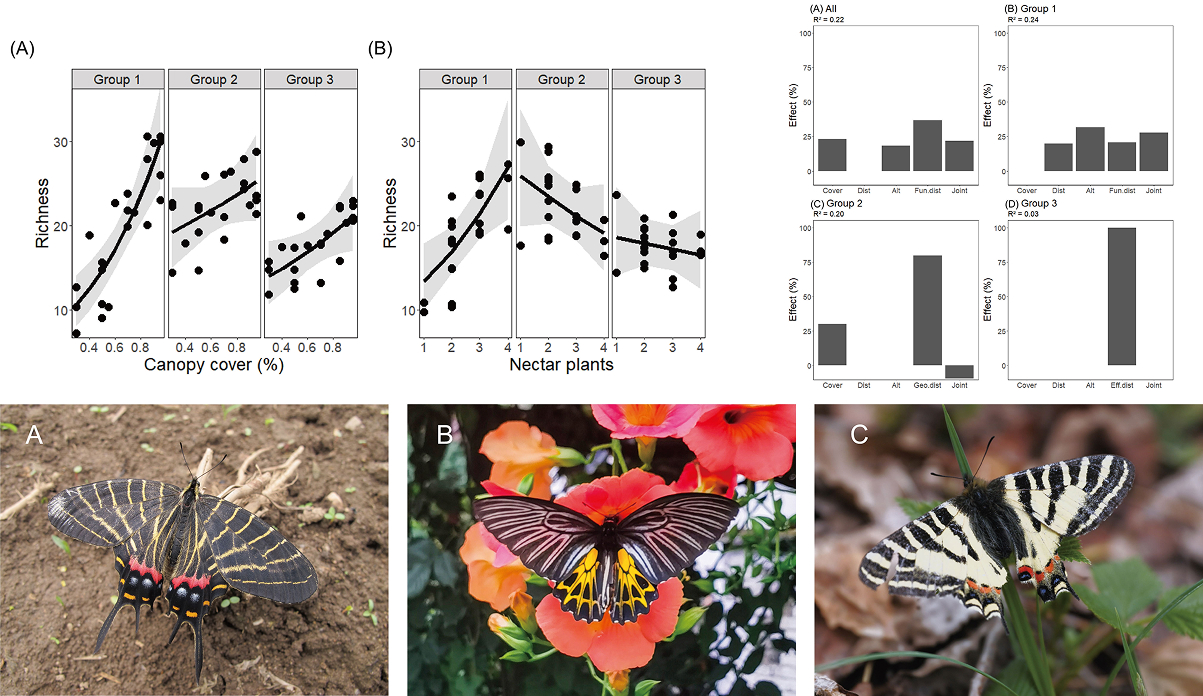
Fig 1: Butterfly communities in western Qinling Mountains show specialist/generalist responses to the environment. Groups: 1 univoltine specialists; 2 bivoltine specialists; 3 generalists. A: Bhutanitis thaidina; B: Troides aeacus; C: Luehdorfia chinensis huashanensis.
New study identifies the butterfly species are most sensitive to environmental change, providing a valuable tool for biodiversity monitoring and conservation.
The international research team studied butterfly communities in the western Qinling Mountains of China, a biodiversity hotspot with more than 400 butterfly species (nearly as many species as e.g. occur in the whole of Europe, 496 species). Decades of logging, agricultural expansion, and habitat fragmentation have significantly altered the landscape, making the region ideal for investigating how butterflies respond to environmental change.
The researchers classified butterflies into three functional groups based on their life cycle and ecological traits: univoltine specialists (one generation per year), bivoltine specialists (two generations per year), and generalists, which can thrive in a wider range of habitats.
The study found that univoltine specialists were the most sensitive to environmental change, responding strongly to habitat quality and food availability. Across all butterfly species, human disturbance reduced abundance, higher elevations supported fewer species, and greater plant resource availability increased butterfly populations. While specialist butterflies were shaped mainly by habitat conditions, generalist species were influenced largely by their ability to move across the landscape.
This three-group classification provides a more detailed understanding of butterfly communities than the traditional specialist-versus-generalist approach widely used in Europe. The findings offer a practical framework for monitoring biodiversity, assessing forest restoration, and identifying habitats most in need of protection.
The research also highlights the conservation importance of specialist butterflies. Several rare species in the Qinling Mountains, including Bhutanitis thaidina and Luehdorfia chinensis huashanensis, are already protected in China. Another species, Luehdorfia taibai, remains critically endangered but is not yet nationally protected. The researchers note that increasing forest canopy density following restoration has reduced suitable habitat for these specialist butterflies, contributing to population declines and local extinctions.
Conclusion
The study demonstrates that considering multiple ecological traits provides a more accurate picture of how butterfly communities respond to environmental change. The researchers conclude that conserving univoltine specialist butterflies should be a priority, with targeted habitat management helping to safeguard biodiversity while improving the long-term health and resilience of forest ecosystems.
About the Research Team
The study was led by Prof. Xiushan Li at China West Normal University in collaboration with Dr. Oliver Schweiger and Prof. Josef Settele from the Helmholtz Centre for Environmental Research (UFZ), Germany, Dr. Martin Wiemers from Senckenberg - Leibniz Institution for Biodiversity and Earth System Research, Germany and further colleagues from China. Using field surveys and ecological modelling, the team investigated how butterfly functional traits influence responses to human disturbance, altitude, and resource availability.
Read the full article here: https://onlinelibrary.wiley.com/doi/10.1111/1744-7917.70332
Andrew Smith
Charlesworth Yansci
+ +44 7478 953600
marketing@charlesworth-group.com
Visit us on social media:
Bluesky
X
Other
Legal Disclaimer:
EIN Presswire provides this news content "as is" without warranty of any kind. We do not accept any responsibility or liability for the accuracy, content, images, videos, licenses, completeness, legality, or reliability of the information contained in this article. If you have any complaints or copyright issues related to this article, kindly contact the author above.
